The Seven Wonders of the Modern World.
Fourth
Position – Great Wall of China.
This Wonder, in my opinion, belongs in the
fourth position because, even though it might have the most interesting,
incredible history and past of all the Wonders, this Wonder is more
characterized by its construction continuity through millenniums rather than
for its structure per se. Because, even though the length is completely
unbelievable, the building remains the same along all its longitude.
Furthermore, though I not consider myself to possess technical knowledge
related to architecture, for me, the architecture of this Wonder in particular
is not impressive, since it is a wall. That is the reason I think the Great Wall of China, though great
indeed, deserves the fourth position.
About the Wonder:
History:
Known as the “Square Wall” and built by the
state of Chu around 7th century BC, this fortification was situated in the
northern part of the kingdom’s capital province. From the 6th to the 4th
century, other states followed this example and thus many other states like the
Zheng, Zhao, Qi, etc. completed their own wall systems.As part of a defensive strategy against the
Xiongnu, a tribal confederation of nomadic peoples, the wall was strengthened
during the reign of the Han emperor Wudi (141–87 BC). The Great Wall also
contributed to the exploitation of farmland in northern and western China and
to the growth of the trade route that came to be known as the Silk Road.
During the Ming dynasty (1368–1644), a major
effort was made to maintain and strengthen the Great Wall to prevent
another Mongolian invasion. Finally, After the Qing (Manchu) dynasty
(1644–1911/12) replaced the Ming dynasty, a change of strategy took place.
Called huairou (“mollification”), the
Qing decided to ease the hostilities with the leaders and peoples of Tibet,
Mongolia, and other nationalities by staying away from their local social,
cultural, or religious life. Since the need for the Great Wall vanished, it
was repaired less frequently.
Importance and
significance:
The Great
Wall has an immeasurable value from a historical point of view. Its
construction began in the 7th century BC, passing through
innumerable dynasties, to finally culminate in the year 1878 (more than 2,000
years of construction!). This wall not only worked as a massive defense
strategy, it also promoted fortune and prosperity since it proportioned a very
solid defense for people to build their homes and make their crops grow. Thanks
to the Great Wall many invasions were avoided and also contributed to
the exploitation of farmland in northern and western China and to the growth of
the trade route that came to be known as the Silk Road.
Third
Position. – Colosseum.
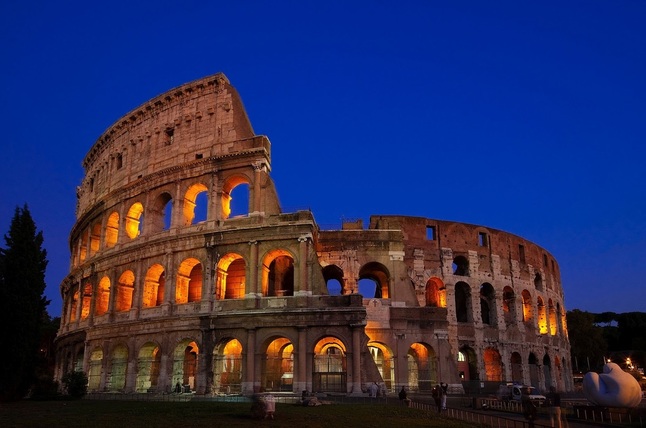
The Colosseum or Coliseum, also known as the Flavian
Amphitheatre, is an oval amphitheatre in the centre of the city of Rome,
Italy. This Wonder deserves the third position because of the great
architectural and republican value that meant, even from the first moment of
its construction, since on the grounds that formed part of the Golden House of Nero, more
specifically, the artificial lake, the Colosseum was constructed. This
change of the Golden House of Nero a
private edification, to the Colosseum a public place aimed to
entertainment meant a lot to the people, and reflected the ideals of both
Emperors. Additionally, what makes this Wonder even more great and fascinating
is the fact that even naval battles took place in this site, which gives us more
merits to imagine how large and extraordinary the Colosseum was.
About the Wonder:
History:
The construction of the Colosseum begins with the
collapse of the Golden House of Nero
(Domus Aurea), in which its grounds was constructed. In front of the Golden House of Nero, Nero created an
artificial lake surrounded by pavilions, gardens and porticoes; and set up the
gigantic bronze Colossus of Nero. Although the Colossus was preserved, much of
the Golden House of Nero was
deconstructed. The lake was filled in and the land reused as the location for
the new Flavian Amphitheatre. The construction began under the rule of
Vespasian in around 70–72 AD (73–75 AD according to some sources). The third
story of the Colosseum would be completed by the time of Vespasian's death in
79. One year later, in 80, the top level would be finished by his son, Titus,
and the inaugural games were held in 80 or 81 AD. According to what it is
generally believed, the decision to build the Colosseum on the site of Nero's
lake.
Importance and
significance:
The importance of the Colosseum is due to its
exceptional level of architecture for that time, it also summarized the Roman
culture and it was Rome’s representation. The fact that it has survived for
nearly 2,000 years, also makes it very interesting. All the history that this
site witnessed makes the Colosseum that important to be
considered as a World Heritage Site and a Wonder of the world. Since it is the most impressive, and at the same
time, tangible record of one of the most influential civilization in history:
the Roman civilization. Furthermore, something that is not always mentioned is
that it could be flooded to hold naval battles, and then bring ships in.


Comentarios
Publicar un comentario